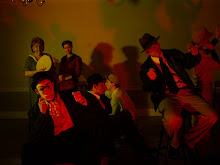
I awoke this morning with two bruised knees. (Insert your own jokes here). In Dog in a Manger I put on a pair of cute cat ears and engage in a raucous courtship dance with my beloved. Yesterday I let things get a little too raucous and tripped over part of the set. Stealthily I pursued my partner offstage on my hands and knees as if to say “Ah, I meant to do that, as my cat-like posture increases my adorability.” I’m sure no one in the audience noticed the blooper… Meow.
Dog in a Manger is gearing up for its final week and the rest of the season is gearing up. I’m helping James and Myah review submissions for January’s Fresh Eyes Festival and researching Rob’s dramaturgical questions for May’s adaptation of An Enemy of the People. Blog posts will resume in December when the Fresh Eyes lineup is ready to announce. Meanwhile I welcome new readers to look through the past few months to learn some fun facts about our cast and our adaptation.
Final performances of Dog in a Manger are October 30, 31 and November 1 at 7:30 pm.
Visit www.redtapetheatre.com for details and to purchase tickets online!
Showing posts with label Dog in a Manger. Show all posts
Showing posts with label Dog in a Manger. Show all posts
Sunday, October 26, 2008

Monday, October 13, 2008
Dog in a Manger Artwork

I thought I'd post my cast artwork for Dog in a Manger. In 1998, inspired by the late Al Hirschfeld, I gave my fellow actors a caricature of the cast as a closing night gift. It went over well so I've kept at it.
For Dog in a Manger I decided to finish it before previews. There was some risk in this as some hairstyles and costumes have altered since then, but as a result I was able to include the image in our lobby display.
Paul G. Miller
Season Dramaturge
Dog in a Manger has been extended through November 1st.
Visit http://www.redtapetheatre.orgfor details and to purchase tickets online!
Saturday, October 11, 2008
"Dog in a Manger" Extends through November 1!
Dog in a Manger is a hit! Thank you all for your feedback and support. The show has been extended through November 1.
THE CRITICS SAY:
"Red Tape Theatre is a young group of talented people... in its quest to create fun, thought provoking, avant-garde theatre. "
" There were some talented people in this cast...A booming Bryan Kelly, the lovely Marika Engelhardt and the very funny Michael Gonring."
"...This little scene [between Gonring and Panger] is worth the price of admission."
-Alan Bresloff, steadstylechicago.com
"Finally, cutting edge theater that requires its audience to have taken Sosc. From Foucault to Freud, from Nietzsche to Marx, you'll find it all in James Palmer's adaptation..."
"Paul Miller plays a Fabio that is so convincingly scummy, I wonder what he is like in real life. Michael Gonring plays a sardonic Tristan very well. Bryan Kelly gives a hilarious turn as Ricardo the inquisitor."
- Pete Russell, Chicago Maroon
THE AUDIENCES SAY:
"I never cease to be amazed by the depth of the Red Tape Theatre productions...presenting substantive, challenging and absorbing plays. It warms my heart to see such pertinent and timely issues being raised..."
"What an AMAZING production. [We] were non-stop back and forth all the way to Evanston last night talking about the characters, the themes, and what it all meant. Incredible, really. "
"I had a great time!"
Tickets are going fast, buy yours now at www.redtapetheatre.org.
THE CRITICS SAY:
"Red Tape Theatre is a young group of talented people... in its quest to create fun, thought provoking, avant-garde theatre. "
" There were some talented people in this cast...A booming Bryan Kelly, the lovely Marika Engelhardt and the very funny Michael Gonring."
"...This little scene [between Gonring and Panger] is worth the price of admission."
-Alan Bresloff, steadstylechicago.com
"Finally, cutting edge theater that requires its audience to have taken Sosc. From Foucault to Freud, from Nietzsche to Marx, you'll find it all in James Palmer's adaptation..."
"Paul Miller plays a Fabio that is so convincingly scummy, I wonder what he is like in real life. Michael Gonring plays a sardonic Tristan very well. Bryan Kelly gives a hilarious turn as Ricardo the inquisitor."
- Pete Russell, Chicago Maroon
THE AUDIENCES SAY:
"I never cease to be amazed by the depth of the Red Tape Theatre productions...presenting substantive, challenging and absorbing plays. It warms my heart to see such pertinent and timely issues being raised..."
"What an AMAZING production. [We] were non-stop back and forth all the way to Evanston last night talking about the characters, the themes, and what it all meant. Incredible, really. "
"I had a great time!"
Tickets are going fast, buy yours now at www.redtapetheatre.org.
Saturday, October 4, 2008
Adapting the Classics – The Master Builder
Red Tape Theatre's panel Adapting the Classics will be presented on Saturday, October 11 at 4:30 p.m., between performances of Dog in a Manger.
Panelist Blake Montgomery is the Artistic Director of The Building Stage (www.buildingstage.com). He co-directed/adapted Henrik Ibsen’s The Master Builder in June 2008. The four person ensemble each took a role in this psychological adaptation set in the head of the title character. Halvard Solness fears the next generation will surpass his lifetime of achievements and lashes out angrily at them. His three young ensemble members switched costumes and roles as his lovers, confidantes and rivals confronted him to offer warnings and advice. As Solness’ mind began to shatter the barriers between the other characters roles began to dissolve.
The Building Stage’s mission states “We believe theater is made, not written. And while each project has its own unique process of creation, each is driven by the spirit of investigation: to ask, through action on the stage, how a piece functions, how it is constructed, and what must be done to make it work.” Red Tape will soon begin work on our own adaptation of Ibsen’s An Enemy of the People. I am thrilled Mr. Montgomery could join our panel and am eager to hear him speak on his company’s creative process. Their current production, Dracula, runs through October 18, 2008.
Other panelists include:
Paul G. Miller
Season Dramaturge
Dog in a Manger opens October 6.
Visit www.redtapetheatre.org for details and to purchase tickets online!
Panelist Blake Montgomery is the Artistic Director of The Building Stage (www.buildingstage.com). He co-directed/adapted Henrik Ibsen’s The Master Builder in June 2008. The four person ensemble each took a role in this psychological adaptation set in the head of the title character. Halvard Solness fears the next generation will surpass his lifetime of achievements and lashes out angrily at them. His three young ensemble members switched costumes and roles as his lovers, confidantes and rivals confronted him to offer warnings and advice. As Solness’ mind began to shatter the barriers between the other characters roles began to dissolve.
The Building Stage’s mission states “We believe theater is made, not written. And while each project has its own unique process of creation, each is driven by the spirit of investigation: to ask, through action on the stage, how a piece functions, how it is constructed, and what must be done to make it work.” Red Tape will soon begin work on our own adaptation of Ibsen’s An Enemy of the People. I am thrilled Mr. Montgomery could join our panel and am eager to hear him speak on his company’s creative process. Their current production, Dracula, runs through October 18, 2008.
Other panelists include:
- Libby Ford, Associate Artistic Director of Greasy Joan & Co.
- Tony Lewis, Artistic Director of MidTangeant Productions
- Katie McLean, Artistic Ensemble Member at Lifeline Theatre Company
Paul G. Miller
Season Dramaturge
Dog in a Manger opens October 6.
Visit www.redtapetheatre.org for details and to purchase tickets online!
Wednesday, October 1, 2008
Adapting the Classics - The Mark of Zorro
Red Tape Theatre's panel Adapting the Classics will be presented on Saturday, October 11 at 4:30 p.m., between performances of Dog in a Manger.
Panelist Katie McLean is an Artistic Ensemble Member at Lifeline Theatre Company (www.lifelinetheatre.com). Her adaptation of The Mark of Zorro last summer was the smashhit of their 2007-2008 season. The production was transferred to the Theatre Building Chicago where it runs September 27-November 23, 2008.
Lifeline Theatre specializes in original literary adaptations, and McLean went back to Zorro's original adventures bypassing an origin story and dropping the audience right in the middle of the action. I was particularly impressed by her handling of his alter ego, a cowardly fop who can't approach a lover without the black mask. McLean, and actor James Elly, explored the delicious ambiguity between the two roles, suggesting that the "real Zorro" lay somewhere in between.
Gay Chicago Magazine put it best when they presented an After Dark Award for Best Production. "This show had everything going for it, both creatively and technically. This magnificently lovable ensemble’s depiction of Katie McLean’s thrilling adaptation, polished off with Dorothy Milne’s brilliantly ingenious direction, created an all ages laugh festival extravaganza that was CRAZY FUN!"
Other panelists include:
Season Dramaturge
Dog in a Manger opens October 6.
Visit www.redtapetheatre.org for details and to purchase tickets online!
Panelist Katie McLean is an Artistic Ensemble Member at Lifeline Theatre Company (www.lifelinetheatre.com). Her adaptation of The Mark of Zorro last summer was the smashhit of their 2007-2008 season. The production was transferred to the Theatre Building Chicago where it runs September 27-November 23, 2008.
Lifeline Theatre specializes in original literary adaptations, and McLean went back to Zorro's original adventures bypassing an origin story and dropping the audience right in the middle of the action. I was particularly impressed by her handling of his alter ego, a cowardly fop who can't approach a lover without the black mask. McLean, and actor James Elly, explored the delicious ambiguity between the two roles, suggesting that the "real Zorro" lay somewhere in between.
Gay Chicago Magazine put it best when they presented an After Dark Award for Best Production. "This show had everything going for it, both creatively and technically. This magnificently lovable ensemble’s depiction of Katie McLean’s thrilling adaptation, polished off with Dorothy Milne’s brilliantly ingenious direction, created an all ages laugh festival extravaganza that was CRAZY FUN!"
Other panelists include:
- Libby Ford, Associate Artistic Director of Greasy Joan & Co.
- Tony Lewis, Artistic Director of MidTangeant Productions
- Blake Montgomery, Artistic Director of The Building Stage
Season Dramaturge
Dog in a Manger opens October 6.
Visit www.redtapetheatre.org for details and to purchase tickets online!
Saturday, September 27, 2008
Meet the Cast! - Bryan Kelly
Part four in a series of interviews with the cast of Dog in a Manger at Red Tape Theatre.
1. Where are you from?
It's hard to say where I'm from. I was born in Hawaii. Then when I was two, we moved to Rochester, NY. In second grade, I stayed briefly in New Jersey, then eventually Long Island until fourth grade when I found myself in Nashua, NH. Then another great opportunity and new job happened for my dad, and we moved to Walled Lake, Michigan for the last two years of high school. Went to Western Michigan in Kalamazoo, then moved to Chicago. After a brief two year stint in LA, I'm back in where I consider home - Chicago.
So the short answer is "I'm from Chicago"
2. What is the first stage play you remember seeing?
I actually wrote a show and performed in two before I saw a live show. In NH high school, I played Lacrosse, Football and Basketball mostly, and for a change, I joined Odyssey of the Mind. We ended up choosing the performance problem and wrote a show in which I was the MC. I did a few shows in high school and it wasn't until I went to college that I actually saw a live theatre performance I was not in. I actually did not realize that until I attempted to answer this question. Interestingly enough, my best friend was in the first show I watched and it was also the first time I met him.
3. When/why did you start acting?
I chose acting on a possible sign and a whim. I thought I was going to be a mechanical engineer, and I had applied to four schools I was kind of interested in. I applied to Western Michigan frankly because there was a small application fee, and no essay. I put Theatre as my major of choice, just to see what could happen. Then, one day, I got the acceptance letter from Western while my mom was driving me to rehearsal. It was an overcast day, and as I opened the letter the clouds parted and light broke through. It was weird to say the least.
Those moments are rare and odd and again, weird. I was mulling over the decision, every day after submitting the application I thought about what to do if it worked out, and although I had missed the first department audition, I was generally accepted to the University. When I read the letter in the sudden sunshine, I just felt confident in going forward in the direction of my dreams. It's funny how a small coincidence can suddenly alter the course of one's major life decisions, and we will mull over what cereal to buy for a good half hour and regret it for days after even when it is clearly delicious. I decided that entertaining is important to me and I want to entertain in all facets. I figured theatre training would be a way to get started. Since then, I've been involved in large and small production theatre, tons of improv, stand-up, sit-coms, movies, shorts, I was a tour manager for the Dollyrots travelling all over the US, I've MC'd several events and I've even presided over two weddings. I love entertaining. If given the choice, I would rather be Willy Wonka than one of the kids.
4. Tell us about your character in Dog in a Manger.
I play Ricardo, the inquisitor. He is an overbearing presence to say the least. As an inquisitor, he is used to being in absolute power in most any situation. Since the inquisition is being dismantled slowly, he finds himself basically waving a gun loaded with blanks. As a man of immense power, he has basically been able to say and do whatever he wants. Power does things to people who crave it, and it has definitely warped Ricardo. He has done so much wrong in the name of right that he believes that everything he does is right by default. This man can convince your mother that you have fosaken all that is good and get her to cast the first stone at your death all in the name of God. Personally, I am a gifted skeptic and devil's advocate and so it is interesting to play a true believer.
5. Do you have a favorite moment/scene in the play?
If I had to pick a scene I really like to do, it'd have to be the first speech to the audience. I've been a stand-up comic and in general a comedy guy for a while, and to be so blatantly evil and mean with a bit of charm is exquisite for me. I've tried to be mostly a gentle giant most of my life on and off stage, so to be able to bring out my inner asshole is really.... relieving.
As for a scene I like to watch, I like when Belflor hits Teo. It's sweet, vengeful, heartbreaking and ridiculous.
6. What's next for you?
What's next? I'm lucky I know what's happening this week. I'm in the pilot episode for A&E's The Beast, so hopefully we'll all see me and other fine Chicago actors in the winter.
Dog in a Manger runs October 2-26.
Visit www.redtapetheatre.com for details and to purchase tickets online!
1. Where are you from?
It's hard to say where I'm from. I was born in Hawaii. Then when I was two, we moved to Rochester, NY. In second grade, I stayed briefly in New Jersey, then eventually Long Island until fourth grade when I found myself in Nashua, NH. Then another great opportunity and new job happened for my dad, and we moved to Walled Lake, Michigan for the last two years of high school. Went to Western Michigan in Kalamazoo, then moved to Chicago. After a brief two year stint in LA, I'm back in where I consider home - Chicago.
So the short answer is "I'm from Chicago"
2. What is the first stage play you remember seeing?
I actually wrote a show and performed in two before I saw a live show. In NH high school, I played Lacrosse, Football and Basketball mostly, and for a change, I joined Odyssey of the Mind. We ended up choosing the performance problem and wrote a show in which I was the MC. I did a few shows in high school and it wasn't until I went to college that I actually saw a live theatre performance I was not in. I actually did not realize that until I attempted to answer this question. Interestingly enough, my best friend was in the first show I watched and it was also the first time I met him.
3. When/why did you start acting?
I chose acting on a possible sign and a whim. I thought I was going to be a mechanical engineer, and I had applied to four schools I was kind of interested in. I applied to Western Michigan frankly because there was a small application fee, and no essay. I put Theatre as my major of choice, just to see what could happen. Then, one day, I got the acceptance letter from Western while my mom was driving me to rehearsal. It was an overcast day, and as I opened the letter the clouds parted and light broke through. It was weird to say the least.
Those moments are rare and odd and again, weird. I was mulling over the decision, every day after submitting the application I thought about what to do if it worked out, and although I had missed the first department audition, I was generally accepted to the University. When I read the letter in the sudden sunshine, I just felt confident in going forward in the direction of my dreams. It's funny how a small coincidence can suddenly alter the course of one's major life decisions, and we will mull over what cereal to buy for a good half hour and regret it for days after even when it is clearly delicious. I decided that entertaining is important to me and I want to entertain in all facets. I figured theatre training would be a way to get started. Since then, I've been involved in large and small production theatre, tons of improv, stand-up, sit-coms, movies, shorts, I was a tour manager for the Dollyrots travelling all over the US, I've MC'd several events and I've even presided over two weddings. I love entertaining. If given the choice, I would rather be Willy Wonka than one of the kids.
4. Tell us about your character in Dog in a Manger.
I play Ricardo, the inquisitor. He is an overbearing presence to say the least. As an inquisitor, he is used to being in absolute power in most any situation. Since the inquisition is being dismantled slowly, he finds himself basically waving a gun loaded with blanks. As a man of immense power, he has basically been able to say and do whatever he wants. Power does things to people who crave it, and it has definitely warped Ricardo. He has done so much wrong in the name of right that he believes that everything he does is right by default. This man can convince your mother that you have fosaken all that is good and get her to cast the first stone at your death all in the name of God. Personally, I am a gifted skeptic and devil's advocate and so it is interesting to play a true believer.
5. Do you have a favorite moment/scene in the play?
If I had to pick a scene I really like to do, it'd have to be the first speech to the audience. I've been a stand-up comic and in general a comedy guy for a while, and to be so blatantly evil and mean with a bit of charm is exquisite for me. I've tried to be mostly a gentle giant most of my life on and off stage, so to be able to bring out my inner asshole is really.... relieving.
As for a scene I like to watch, I like when Belflor hits Teo. It's sweet, vengeful, heartbreaking and ridiculous.
6. What's next for you?
What's next? I'm lucky I know what's happening this week. I'm in the pilot episode for A&E's The Beast, so hopefully we'll all see me and other fine Chicago actors in the winter.
Dog in a Manger runs October 2-26.
Visit www.redtapetheatre.com for details and to purchase tickets online!
Wednesday, September 24, 2008
Two Takes on Fuente Ovejuna
Fuente Ovejuna (or The Sheep Well) is one of Lope de Vega’s best known works. It was interesting to re-read this midway through the rehearsal process for Dog in a Manger.
A wicked Commander terrorizes the villagers of the title town and deflowers all the maidens on their wedding nights. When Laurencia resists, and is violently raped for it, she leads the villagers in bloodthirsty rebellion. The Commander and his men are slaughtered at her command, making her one of de Vega’s most proactive heroines.
LAURENCIA: “I swear to God above that women alone shall be responsible for their honour, for their blood, and make these traitors, these tyrants pay…. And once again we’ll see that age return where there were women who were strong, true Amazons, whose deeds amazed the world.” (translation by Gwynne Edwards)
King Fernando and Queen Isabel send a magistrate to investigate the Commander’s death. Despite torture and imprisonment, when the people are asked who killed the Commander they claim it as a group crying “Fuente Ovejuna!” When the people report the Commander’s misdeeds and his rebellion against the crown to the King he pardons the entire town.
In his introduction to the play Gwynne Edwards writes that the play does not advocate revolution. “Rather, [de Vega] shared the desire of his contemporaries for the continuity of established social structures, ending the play, therefore, not with the victory of the citizens but with the restitution of order by the Catholic Kings.” Even so, the people demand responsibility from their King as they did from their Commander. Though peasants, their honor is no less than that of any so-called nobility.
Dog in a Manger focuses on a conflict between a Countess and her servants. Both sides disrupt the status quo. Neither will back down as each regards their honor as something worth defending. While the Countess is a nobler specimen than Fuente’s Commander, she too learns the dangers of underestimating the lower classes.
Paul G. Miller
Season Dramaturge
Dog in a Manger opens October 6.
Visit www.redtapetheatre.org for details and to purchase tickets online!
A wicked Commander terrorizes the villagers of the title town and deflowers all the maidens on their wedding nights. When Laurencia resists, and is violently raped for it, she leads the villagers in bloodthirsty rebellion. The Commander and his men are slaughtered at her command, making her one of de Vega’s most proactive heroines.
LAURENCIA: “I swear to God above that women alone shall be responsible for their honour, for their blood, and make these traitors, these tyrants pay…. And once again we’ll see that age return where there were women who were strong, true Amazons, whose deeds amazed the world.” (translation by Gwynne Edwards)
King Fernando and Queen Isabel send a magistrate to investigate the Commander’s death. Despite torture and imprisonment, when the people are asked who killed the Commander they claim it as a group crying “Fuente Ovejuna!” When the people report the Commander’s misdeeds and his rebellion against the crown to the King he pardons the entire town.
In his introduction to the play Gwynne Edwards writes that the play does not advocate revolution. “Rather, [de Vega] shared the desire of his contemporaries for the continuity of established social structures, ending the play, therefore, not with the victory of the citizens but with the restitution of order by the Catholic Kings.” Even so, the people demand responsibility from their King as they did from their Commander. Though peasants, their honor is no less than that of any so-called nobility.
Dog in a Manger focuses on a conflict between a Countess and her servants. Both sides disrupt the status quo. Neither will back down as each regards their honor as something worth defending. While the Countess is a nobler specimen than Fuente’s Commander, she too learns the dangers of underestimating the lower classes.
Paul G. Miller
Season Dramaturge
Dog in a Manger opens October 6.
Visit www.redtapetheatre.org for details and to purchase tickets online!
Saturday, September 20, 2008
Adapting the Classics – Midsummer
Red Tape Theatre's panel Adapting the Classics will be presented on Saturday, October 11 at 4:30 p.m., between performances of Dog in a Manger.
Panelist Tony Lewis is the Artistic Director for Midtangeant Productions (http://www.myspace.com/midtangent). They've had great success with their production of A Midsummer Night's Dream: A Queer Tale which I had the good fortune to see in its third revival this July.
Tony's production of Shakespeare's comedy cast Lysander as a no-nonsense lesbian, Helena as a lonely gay man, and Titania as a fantabulous drag queen. When Lysander and Hermia flee the king's persecution, Demetrius gives chase with lovesick Helena close behind. They find themselves in the Boyshood ruled over by Titania and her band of pansexual, club-kid fairies. Love and sexuality prove fluid as Puck's drugs cause couples to mix and match in all combinaitons.
Tony's adaptation was brash, raucous and loaded with sex, but there were more tricks up his sleeve. Not every character in the play was happy to discover their sexuality and the final scene at court turned unexpectedly tragic. This scene fascinated me and convinced me that Tony was someone to invite to our panel.
Other panelists include:
Season Dramaturge
Dog in a Manger opens October 6.
Visit http://www.redtapetheatre.org/ for details and to purchase tickets online!
Panelist Tony Lewis is the Artistic Director for Midtangeant Productions (http://www.myspace.com/midtangent). They've had great success with their production of A Midsummer Night's Dream: A Queer Tale which I had the good fortune to see in its third revival this July.
Tony's production of Shakespeare's comedy cast Lysander as a no-nonsense lesbian, Helena as a lonely gay man, and Titania as a fantabulous drag queen. When Lysander and Hermia flee the king's persecution, Demetrius gives chase with lovesick Helena close behind. They find themselves in the Boyshood ruled over by Titania and her band of pansexual, club-kid fairies. Love and sexuality prove fluid as Puck's drugs cause couples to mix and match in all combinaitons.
Tony's adaptation was brash, raucous and loaded with sex, but there were more tricks up his sleeve. Not every character in the play was happy to discover their sexuality and the final scene at court turned unexpectedly tragic. This scene fascinated me and convinced me that Tony was someone to invite to our panel.
Other panelists include:
- Libby Ford, Associate Artistic Director of Greasy Joan & Co.
- Katie McLean, Artistic Ensemble Member at Lifeline Theatre Company
- Blake Montgomery, Artistic Director of The Building Stage
Season Dramaturge
Dog in a Manger opens October 6.
Visit http://www.redtapetheatre.org/ for details and to purchase tickets online!
Wednesday, September 17, 2008
Meet the Cast! – Paul G. Miller
Part three in a series of interviews with the cast of Dog in a Manger at Red Tape Theatre.
1. Where are you from?
I was born and raised in Corvallis, OR. I moved to Portland, OR in 1998 and Chicago in 2006.
2. What is the first stage play you remember seeing?
My grandmother was directing a production of Little Women at the local arts center. I’d go with her to rehearsals and helped her build the set. There’s a scene where the March sisters put on a melodrama. Grandma built a “Castle tower” out of a large cardboard box. We colored the exterior together with pastel markers. When the show reached performance I got scolded because I knew all the jokes and would laugh loudly before the rest of the audience could respond. I didn’t realize I was being rude. I was just loving the play!
3. When/why did you start acting?
Grandmother again. She gave me two roles in a children’s theatre when I was very small. I played a servant in The Emperor’s New Clothes who rang a gong when the emperor appeared, then a turtle in Red Riding Hood with a big paper mache shell. I was tiny with a loud voice and the grown ups thought I was adorable. I loved the attention. Then I auditioned for some other companies and discovered that being adorable wasn’t enough to get me cast. My bruised ego, and the dreadful pageants at my elementary school, were enough to keep me from acting again till high school. By then I was no longer adorable, just closeted and socially awkward. The theatre scene helped me make friends, come out, and try on some new identities. It’s been a rocky romance ever since.
4. Tell us about your character in Dog in a Manger.
Fabio is bodyguard and confidante to the Countess Belflor. In a play about changing social roles, Fabio is an advocate for the status quo. He wants to be a protector but his fear of the Inquisition, and of change in general, causes him to give some very poor advice. It isn’t until others start breaking the rules that he finds the courage to pursue a love of his own.
5. Do you have a favorite moment/scene in the play?
Fabio gets to perform a little dance, which I’ve enjoyed learning. However my favorite moment would have to be a speech late in the play where Fabio finally speaks his mind about all the chaos that’s been going on around him. He spends most of the play biting his tongue so it’s a relief to finally cut loose.
6. What’s next for you?
This fall I’ll be co-organizing Red Tape’s Fresh Eyes Festival and doing dramaturgical research for our original adaptation of An Enemy of the People. Acting-wise it’s simply a matter of audition, audition, audition.
Dog in a Manger runs October 2-26.
Visit www.redtapetheatre.com for details and to purchase tickets online!
1. Where are you from?
I was born and raised in Corvallis, OR. I moved to Portland, OR in 1998 and Chicago in 2006.
2. What is the first stage play you remember seeing?
My grandmother was directing a production of Little Women at the local arts center. I’d go with her to rehearsals and helped her build the set. There’s a scene where the March sisters put on a melodrama. Grandma built a “Castle tower” out of a large cardboard box. We colored the exterior together with pastel markers. When the show reached performance I got scolded because I knew all the jokes and would laugh loudly before the rest of the audience could respond. I didn’t realize I was being rude. I was just loving the play!
3. When/why did you start acting?
Grandmother again. She gave me two roles in a children’s theatre when I was very small. I played a servant in The Emperor’s New Clothes who rang a gong when the emperor appeared, then a turtle in Red Riding Hood with a big paper mache shell. I was tiny with a loud voice and the grown ups thought I was adorable. I loved the attention. Then I auditioned for some other companies and discovered that being adorable wasn’t enough to get me cast. My bruised ego, and the dreadful pageants at my elementary school, were enough to keep me from acting again till high school. By then I was no longer adorable, just closeted and socially awkward. The theatre scene helped me make friends, come out, and try on some new identities. It’s been a rocky romance ever since.
4. Tell us about your character in Dog in a Manger.
Fabio is bodyguard and confidante to the Countess Belflor. In a play about changing social roles, Fabio is an advocate for the status quo. He wants to be a protector but his fear of the Inquisition, and of change in general, causes him to give some very poor advice. It isn’t until others start breaking the rules that he finds the courage to pursue a love of his own.
5. Do you have a favorite moment/scene in the play?
Fabio gets to perform a little dance, which I’ve enjoyed learning. However my favorite moment would have to be a speech late in the play where Fabio finally speaks his mind about all the chaos that’s been going on around him. He spends most of the play biting his tongue so it’s a relief to finally cut loose.
6. What’s next for you?
This fall I’ll be co-organizing Red Tape’s Fresh Eyes Festival and doing dramaturgical research for our original adaptation of An Enemy of the People. Acting-wise it’s simply a matter of audition, audition, audition.
Dog in a Manger runs October 2-26.
Visit www.redtapetheatre.com for details and to purchase tickets online!
Friday, September 12, 2008
Adapting the Classics – The Misanthrope
Red Tape Theatre's panel Adapting the Classics will be presented on Saturday, October 11 at 4:30 p.m., between performances of Dog in a Manger. I'll be devoting a post to each of our panelists, starting with Libby Ford.
Libby Ford is the Associate Artistic Director of Greasy Joan & Co. (www.greasyjoan.org) where she recently directed Moliere's The Misanthrope. Set in a crumbling city, the social climbing characters did their best to ignore the gaping whole in the wall of Celimene's boudoir. Bedecked in 1980's finery they sniped, gossiped and formed alliances in a world that had no rewards to give them. Alceste, the misanthrope of the title, ignored the door and entered through the wall itself; a prelude to the illusions he would shatter.The production opened at the Athenaeum Theatre in March 2008 and was revived at Theatre on the Lake that June.
Greasy Joan's mission is to re-imagine classic plays for the contemporary stage. I'll be asking Libby about the company as a whole but particularly look forward to a discussion of The Misanthrope.
Other panelists include:
Paul G. Miller
Season Dramaturge
Dog in a Manger runs October 6-26.
Visit www.redtapetheatre.org for details and to purchase tickets online!
Libby Ford is the Associate Artistic Director of Greasy Joan & Co. (www.greasyjoan.org) where she recently directed Moliere's The Misanthrope. Set in a crumbling city, the social climbing characters did their best to ignore the gaping whole in the wall of Celimene's boudoir. Bedecked in 1980's finery they sniped, gossiped and formed alliances in a world that had no rewards to give them. Alceste, the misanthrope of the title, ignored the door and entered through the wall itself; a prelude to the illusions he would shatter.The production opened at the Athenaeum Theatre in March 2008 and was revived at Theatre on the Lake that June.
Greasy Joan's mission is to re-imagine classic plays for the contemporary stage. I'll be asking Libby about the company as a whole but particularly look forward to a discussion of The Misanthrope.
Other panelists include:
- Tony Lewis, Artistic Director of Midtangent Productions
- Katie McLean, Artistic Ensemble Member at Lifeline Theatre Company
- Blake Montgomery, Artistic Director of The Building Stage
Paul G. Miller
Season Dramaturge
Dog in a Manger runs October 6-26.
Visit www.redtapetheatre.org for details and to purchase tickets online!
Wednesday, September 10, 2008
Meet the Cast! – Marika Engelhardt
Part two in a series of interviews with the cast of Dog in a Manger at Red Tape Theatre.
1. Where are you from?
I'm from Portland, Oregon.
2. What is the first stage play you remember seeing?
The first play I really remember seeing, and more importantly, liking, was a production of Waiting for Godot at the college where my father taught. It's one of his favorite plays (and now mine), and I found the show really moving. The actors in that show really have to explore what it means to be on this earth, and it demands intelligence and bravery.
3. When/why did you start acting?
I started acting when I was little, I would write fake tv commercials and perform them live for my parents. I saw other people acting and I thought: that looks like an awesome job!
4. Tell us about your character in Dog in a Manger.
Diana is a countess during the Spanish inquisition. She is the ultimate matriarch. She is a powerful woman, someone who has to take charge and provide for those around her. She comes across as cold and temperamental, but those traits are what help her manage her enormous responsibilities.
5. Do you have a favorite moment/scene in the play?
My favorite moment in the play is probably a monologue in which I express my private thoughts about love. It is a rare moment for the audience to see Diana in a vulnerable moment, and I think it shows how human she is underneath and how important it is to maintain a controlled exterior to the world.
6. What’s next for you?
What's next? Continue to get to know the Chicago arts community and involve myself with projects that excite me!
Dog in a Manger runs October 2-26.
Visit www.redtapetheatre.com for details and to purchase tickets online!
1. Where are you from?
I'm from Portland, Oregon.
2. What is the first stage play you remember seeing?
The first play I really remember seeing, and more importantly, liking, was a production of Waiting for Godot at the college where my father taught. It's one of his favorite plays (and now mine), and I found the show really moving. The actors in that show really have to explore what it means to be on this earth, and it demands intelligence and bravery.
3. When/why did you start acting?
I started acting when I was little, I would write fake tv commercials and perform them live for my parents. I saw other people acting and I thought: that looks like an awesome job!
4. Tell us about your character in Dog in a Manger.
Diana is a countess during the Spanish inquisition. She is the ultimate matriarch. She is a powerful woman, someone who has to take charge and provide for those around her. She comes across as cold and temperamental, but those traits are what help her manage her enormous responsibilities.
5. Do you have a favorite moment/scene in the play?
My favorite moment in the play is probably a monologue in which I express my private thoughts about love. It is a rare moment for the audience to see Diana in a vulnerable moment, and I think it shows how human she is underneath and how important it is to maintain a controlled exterior to the world.
6. What’s next for you?
What's next? Continue to get to know the Chicago arts community and involve myself with projects that excite me!
Dog in a Manger runs October 2-26.
Visit www.redtapetheatre.com for details and to purchase tickets online!
Sunday, September 7, 2008
Adapting the Classics – Peter Brook’s thoughts
Red Tape Theatre’s adaptation of Dog in a Manger takes the plot and central characters from Lope de Vega’s play and weaves them into a script with several new surprises. On Saturday, October 11 at 4:30 p.m., I’ll be hosting a special panel of Chicago artists who’ve put their own spin on classical works. The panelists for Adapting the Classics include:
I’ll be posting a series of blogs about their recent productions this month, but first I thought I’d share a quote from a recent article about director Peter Brook.
“He [Brook] thinks that the writer’s words are always sancrosanct, but that the stage directions can legitimately be modified. ‘The two things come from different sources,’ he argues controversially." *
Some of our panelists created their own texts while others found ways to update the plays without changing a word. We look forward to hearing our panelists thoughts on this process!
Paul G. Miller
Season Dramaturge
* The full Peter Brooke article was published in The Independent, September 5, 2008 and can be read here: http://tinyurl.com/65doyd
Dog in a Manger runs October 6-26.
Visit http://www.redtapetheatre.com/ for details and to purchase tickets online!
- Libby Ford, Associate Artistic Director of Greasy Joan Theatre Company
- Tony Lewis, Artistic Director of Midtangent Productions
- Katie McLean, Artistic Ensemble Member at Lifeline Theatre Company
- Blake Montgomery, Artistic Director of The Building Stage
I’ll be posting a series of blogs about their recent productions this month, but first I thought I’d share a quote from a recent article about director Peter Brook.
“He [Brook] thinks that the writer’s words are always sancrosanct, but that the stage directions can legitimately be modified. ‘The two things come from different sources,’ he argues controversially." *
Some of our panelists created their own texts while others found ways to update the plays without changing a word. We look forward to hearing our panelists thoughts on this process!
Paul G. Miller
Season Dramaturge
* The full Peter Brooke article was published in The Independent, September 5, 2008 and can be read here: http://tinyurl.com/65doyd
Dog in a Manger runs October 6-26.
Visit http://www.redtapetheatre.com/ for details and to purchase tickets online!
Saturday, August 30, 2008
Q and A: Choose Your Own Adventure
QUESTION – Red Tape’s Adaptation of Dog in a Manger has gone through multiple endings in the writing process. How did Lope de Vega end the original?
ANSWER – I’ll keep the Red Tape production spoiler free. If you don’t want de Vega’s original ending revealed, read no further.
Still with me? The central conflict of de Vega's The Dog in the Manger involves a Countess who falls for her secretary, Teodoro. The Countess can not have the lower class man for herself but cannot abide his engagement to another. Teodoro’s servant Tristan cons an old nobleman, Ludovico, into claiming Teodoro as his long lost son. The Countess sees through the deception and must decide whether or not to play along.
Lope de Vega was able to claim his Deux Ex Machina and mock it too. In a different play Teodoro’s noble parentage would be true, but in de Vega’s play it is blatantly contrived and few believe it. Through Ludovico the playwright mocks the shallowness of social prestige as well as the impossibility of theatrical happy endings.
In Red Tape’s adaptation the Countess has the Inquisition and her own pride to deal with along with class prejudice. While the character of Ludovico was experimented with in the workshops he has since been cut from our script, leaving our protagonists with no easy solutions.
Paul G. Miller
Season Dramaturge
For more information on Dog in a Manger visit here:www.redtapetheatre.org.
ANSWER – I’ll keep the Red Tape production spoiler free. If you don’t want de Vega’s original ending revealed, read no further.
Still with me? The central conflict of de Vega's The Dog in the Manger involves a Countess who falls for her secretary, Teodoro. The Countess can not have the lower class man for herself but cannot abide his engagement to another. Teodoro’s servant Tristan cons an old nobleman, Ludovico, into claiming Teodoro as his long lost son. The Countess sees through the deception and must decide whether or not to play along.
Lope de Vega was able to claim his Deux Ex Machina and mock it too. In a different play Teodoro’s noble parentage would be true, but in de Vega’s play it is blatantly contrived and few believe it. Through Ludovico the playwright mocks the shallowness of social prestige as well as the impossibility of theatrical happy endings.
In Red Tape’s adaptation the Countess has the Inquisition and her own pride to deal with along with class prejudice. While the character of Ludovico was experimented with in the workshops he has since been cut from our script, leaving our protagonists with no easy solutions.
Paul G. Miller
Season Dramaturge
For more information on Dog in a Manger visit here:www.redtapetheatre.org.
Wednesday, August 27, 2008
Q and A: Chaos is a Snake
QUESTION – In Red Tape’s adaptation of Dog in a Manger, a philosopher speaks of a snake affixed to the soil by “the staff of Hermes.” What is the origin of this tale?
ANSWER – The staff of Hermes, or caduceus, comes from Greek myth. The traditional image depicts a staff with wings and two snakes wrapped around it. Another Greek symbol, the rod of Asclepius, features a single snake round a staff and no wings. The American Medical Association includes the latter in its logo, and both have been associated with healing.
While snakes have been gods, or battled gods, in many ancient religions and myths the Greek god Hermes is said to have used his staff to split two warring snakes, bringing peace between them. Hermes was known as the messenger of the gods and a protector to athletes, travelers and thieves.
In Dog in a Manger the servant Tristan comes across the story during his travels. He seeks to bring peace to his unstable home and separate the furious lady of the household from her equally dangerous foes. What he finds on his travels solves one problem, and causes others.
Paul G. Miller
Season Dramaturge
For more information on Dog in a Manger visit here:www.redtapetheatre.org.
ANSWER – The staff of Hermes, or caduceus, comes from Greek myth. The traditional image depicts a staff with wings and two snakes wrapped around it. Another Greek symbol, the rod of Asclepius, features a single snake round a staff and no wings. The American Medical Association includes the latter in its logo, and both have been associated with healing.
While snakes have been gods, or battled gods, in many ancient religions and myths the Greek god Hermes is said to have used his staff to split two warring snakes, bringing peace between them. Hermes was known as the messenger of the gods and a protector to athletes, travelers and thieves.
In Dog in a Manger the servant Tristan comes across the story during his travels. He seeks to bring peace to his unstable home and separate the furious lady of the household from her equally dangerous foes. What he finds on his travels solves one problem, and causes others.
Paul G. Miller
Season Dramaturge
For more information on Dog in a Manger visit here:www.redtapetheatre.org.
Saturday, August 23, 2008
Q and A: The Map of Borges
QUESTION – In Red Tape’s adaptation of Dog in a Manger, the Countess Belflor tells a story about the map of Borges. What is the origin of this tale?
ANSWER – The story Del Rigor en la Ciencia (On Rigor in Science) was written by Jorge Luis Borges and first published in 1946. A translation by Andrew Hurley reads:
“In that Empire, the Art of Cartography attained such Perfection that the map of a single Province occupied the entirety of a City, and the map of the Empire, the entirety of a Province. In time, those Unconscionable Maps no longer satisfied, and the Cartographers Guilds struck a Map of the Empire whose size was that of the Empire, and which coincided point for point with it. The following Generations, who were not so fond of the Study of Cartography as their Forebears had been, saw that that vast Map was Useless.”
The map was at last allowed to rot, revealing the true kingdom underneath. The story was referenced by the French philosopher Jean Baudrillard in his 1985 treatise Simulacra and Simulation which Red Tape Theatre studied in our lab series last season. Baudrillard writes:
“The territory no longer precedes the map, nor does it survive it…. It is the real, and not the map, whose vestiges persist here and there in the deserts that are no longer those of the Empire, but ours. The desert of the real itself.”
In a society where the genteel social codes have failed to obscure their underlying prejudices the Countess Belflor finds the map of Borges a most appropriate example.
Paul G. Miller
Season Dramaturge
For more information on Dog in a Manger visit here:
http://www.redtapetheatre.org/.
ANSWER – The story Del Rigor en la Ciencia (On Rigor in Science) was written by Jorge Luis Borges and first published in 1946. A translation by Andrew Hurley reads:
“In that Empire, the Art of Cartography attained such Perfection that the map of a single Province occupied the entirety of a City, and the map of the Empire, the entirety of a Province. In time, those Unconscionable Maps no longer satisfied, and the Cartographers Guilds struck a Map of the Empire whose size was that of the Empire, and which coincided point for point with it. The following Generations, who were not so fond of the Study of Cartography as their Forebears had been, saw that that vast Map was Useless.”
The map was at last allowed to rot, revealing the true kingdom underneath. The story was referenced by the French philosopher Jean Baudrillard in his 1985 treatise Simulacra and Simulation which Red Tape Theatre studied in our lab series last season. Baudrillard writes:
“The territory no longer precedes the map, nor does it survive it…. It is the real, and not the map, whose vestiges persist here and there in the deserts that are no longer those of the Empire, but ours. The desert of the real itself.”
In a society where the genteel social codes have failed to obscure their underlying prejudices the Countess Belflor finds the map of Borges a most appropriate example.
Paul G. Miller
Season Dramaturge
For more information on Dog in a Manger visit here:
http://www.redtapetheatre.org/.
Monday, August 18, 2008
The Many Loves of Lope de Vega
Lope de Vega (1562-1635) married two women, seduced many more, sired at least ten children, and wrote over 1000 plays before ending his life as a member of the priesthood. While he created many strong roles for women, his witty heroines were often as mistreated and abused as his own mistresses.
On such mistress, the actress Elena Osario first crossed paths with de Vega in 1583. Their passionate affair was ended when she married a wealthy protector. He made her the subject of a scathing novel, Dorotea, in which the heroine misuses her lover and her new husband in turn. Extra venom was unleashed against the character of Dorotea’s mother who arranges the marriage to secure her families fortunes. The ensuing libel suit resulted in de Vega’s temporary banishment from Madrid. Incriminating love letters were used as evidence in the trial (and a device in his plays).
Despite his wild lifestyle de Vega was beloved by king, country, military and church. “Es de Lope” became a descriptive phrase for anything of high quality. He even spent some time in the Inquisition: “The Spanish Inquisition accepted him by making him one of its judges. He became official censor and granter of the indisepensible nihil obstat, or imprimatur.” (Hayes, Francis C., Lope de Vega, Twayne Publishers Inc., 1967) The imprimatur was the declaration that a book was moral and acceptable for Roman Catholic readers. de Vega new a thing or two about the power of writing. The disconnect between his social roles and his passions would continue to be channeled through the characters in his plays as his career blossomed.
Paul G. Miller
Season Dramaturge
For more information on Dog in a Manger visit here:
http://www.redtapetheatre.org/.
On such mistress, the actress Elena Osario first crossed paths with de Vega in 1583. Their passionate affair was ended when she married a wealthy protector. He made her the subject of a scathing novel, Dorotea, in which the heroine misuses her lover and her new husband in turn. Extra venom was unleashed against the character of Dorotea’s mother who arranges the marriage to secure her families fortunes. The ensuing libel suit resulted in de Vega’s temporary banishment from Madrid. Incriminating love letters were used as evidence in the trial (and a device in his plays).
Despite his wild lifestyle de Vega was beloved by king, country, military and church. “Es de Lope” became a descriptive phrase for anything of high quality. He even spent some time in the Inquisition: “The Spanish Inquisition accepted him by making him one of its judges. He became official censor and granter of the indisepensible nihil obstat, or imprimatur.” (Hayes, Francis C., Lope de Vega, Twayne Publishers Inc., 1967) The imprimatur was the declaration that a book was moral and acceptable for Roman Catholic readers. de Vega new a thing or two about the power of writing. The disconnect between his social roles and his passions would continue to be channeled through the characters in his plays as his career blossomed.
Paul G. Miller
Season Dramaturge
For more information on Dog in a Manger visit here:
http://www.redtapetheatre.org/.
Thursday, August 14, 2008
Q and A - Can Ricardo Get Married?
Rehearsals for Dog in a Manger have begun and I've decided to use the blog as a spot for answering actor questions, like this one that came up in the workshop.
QUESTION – If you make Diana's suitor, Ricardo, an Inquisitor, is he still allowed to marry?
ANSWER – Yes. The Spanish Inquisition accepted laymen as well as clergy into their ranks. Ricardo need not be a priest to reach the rank of inquisitor.
Historian Henry Kamen writes:
"Contrary to the image – still widely current – of inquisitors as small-minded clerics and theologians fanatically dedicated to the extirpation of heresy, it must be stressed that, in the sixteenth and seventeenth centuries at least, the inquisitors were an elite bureaucracy. Because the Inquisition was a court, its administrators had to be trained lawyers…. By the same token, inquisitors did not have to be clergy and could be laymen. All this shows that the inquisitors were in principle a bureaucracy not of the Church but of the State: they received their training in the same institutions that contributed personnel to the councils of state, corregidorships and high courts…. [For many] service in the Inquisition was merely a stepping stone to a further career."
(Inquisition and society in Spain in the sixteenth and seventeenth centuries, Bloomington, Indiana University Press, 1985)
Paul G. Miller
Season Dramaturge
For more information on Dog in a Manger visit here: www.redtapetheatre.org
QUESTION – If you make Diana's suitor, Ricardo, an Inquisitor, is he still allowed to marry?
ANSWER – Yes. The Spanish Inquisition accepted laymen as well as clergy into their ranks. Ricardo need not be a priest to reach the rank of inquisitor.
Historian Henry Kamen writes:
"Contrary to the image – still widely current – of inquisitors as small-minded clerics and theologians fanatically dedicated to the extirpation of heresy, it must be stressed that, in the sixteenth and seventeenth centuries at least, the inquisitors were an elite bureaucracy. Because the Inquisition was a court, its administrators had to be trained lawyers…. By the same token, inquisitors did not have to be clergy and could be laymen. All this shows that the inquisitors were in principle a bureaucracy not of the Church but of the State: they received their training in the same institutions that contributed personnel to the councils of state, corregidorships and high courts…. [For many] service in the Inquisition was merely a stepping stone to a further career."
(Inquisition and society in Spain in the sixteenth and seventeenth centuries, Bloomington, Indiana University Press, 1985)
Paul G. Miller
Season Dramaturge
For more information on Dog in a Manger visit here: www.redtapetheatre.org
Subscribe to:
Posts (Atom)