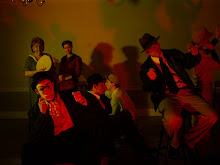
Part two in a series of interviews with the cast of Dog in a Manger at Red Tape Theatre.
1. Where are you from?
I'm from Portland, Oregon.
2. What is the first stage play you remember seeing?
The first play I really remember seeing, and more importantly, liking, was a production of Waiting for Godot at the college where my father taught. It's one of his favorite plays (and now mine), and I found the show really moving. The actors in that show really have to explore what it means to be on this earth, and it demands intelligence and bravery.
3. When/why did you start acting?
I started acting when I was little, I would write fake tv commercials and perform them live for my parents. I saw other people acting and I thought: that looks like an awesome job!
4. Tell us about your character in Dog in a Manger.
Diana is a countess during the Spanish inquisition. She is the ultimate matriarch. She is a powerful woman, someone who has to take charge and provide for those around her. She comes across as cold and temperamental, but those traits are what help her manage her enormous responsibilities.
5. Do you have a favorite moment/scene in the play?
My favorite moment in the play is probably a monologue in which I express my private thoughts about love. It is a rare moment for the audience to see Diana in a vulnerable moment, and I think it shows how human she is underneath and how important it is to maintain a controlled exterior to the world.
6. What’s next for you?
What's next? Continue to get to know the Chicago arts community and involve myself with projects that excite me!
Dog in a Manger runs October 2-26.
Visit www.redtapetheatre.com for details and to purchase tickets online!
Showing posts with label Diana. Show all posts
Showing posts with label Diana. Show all posts
Wednesday, September 10, 2008

Friday, June 27, 2008
The Fate of Our Heroine
The title character of The Dog in the Manger is the Countess Diana. Like the dog in Aesop’s fable she’ll not allow others to enjoy what she cannot. In the dog’s case it was food. In Diana’s it is the love of her servant, Teodoro. Her rank gives her power over him, which she enjoys, but this power would vanish if she wed him.
Diana’s decision to wed could reduce her to the status of property. It’s a serious dilemma when one considers that the heroines in Lope de Vega’s plays were often abandoned, raped or killed by their men. Lope highlighted marriage's contradictions in the play Justice without Revenge. When the heroine learns of her husband's affairs she has one of her own. He responds by slaughtering her to restore his "honor." Though frowned upon, a husband in 17th Century Spain was within his rights to murder a wife suspected of adultery, while women had no such legal recourse.
Diana is not slaughtered but she fits other patterns. A recurring figure in de Vega’s comedies was the mujer esquiva; a woman averse to marriage. Her plight is well explored in Women and Society in the Spanish Drama of the Golden Age by Melveena McKendrick (1974). Rather than explore the rational arguments for her singledom, de Vega would make it the result of vanity or pride that must be overcome by the hero. Still he allowed his women to battle against social convention before restoring the status quo. McKendrick concludes “By the standards of their day the Spanish dramatists of the Golden Age were enlightened and sympathetic men in their attitude to women. One cannot ask for more.” How much more should Diana ask of us in 2008? How could she win Teodoro and keep her self respect? de Vega himself provides an answer that we look forward to revealing this fall!
Paul G. Miller
Season Dramaturge
For more information on our production of The Dog in the Manger please visit http://www.redtapetheatre.org/.
Diana’s decision to wed could reduce her to the status of property. It’s a serious dilemma when one considers that the heroines in Lope de Vega’s plays were often abandoned, raped or killed by their men. Lope highlighted marriage's contradictions in the play Justice without Revenge. When the heroine learns of her husband's affairs she has one of her own. He responds by slaughtering her to restore his "honor." Though frowned upon, a husband in 17th Century Spain was within his rights to murder a wife suspected of adultery, while women had no such legal recourse.
Diana is not slaughtered but she fits other patterns. A recurring figure in de Vega’s comedies was the mujer esquiva; a woman averse to marriage. Her plight is well explored in Women and Society in the Spanish Drama of the Golden Age by Melveena McKendrick (1974). Rather than explore the rational arguments for her singledom, de Vega would make it the result of vanity or pride that must be overcome by the hero. Still he allowed his women to battle against social convention before restoring the status quo. McKendrick concludes “By the standards of their day the Spanish dramatists of the Golden Age were enlightened and sympathetic men in their attitude to women. One cannot ask for more.” How much more should Diana ask of us in 2008? How could she win Teodoro and keep her self respect? de Vega himself provides an answer that we look forward to revealing this fall!
Paul G. Miller
Season Dramaturge
For more information on our production of The Dog in the Manger please visit http://www.redtapetheatre.org/.
Subscribe to:
Posts (Atom)